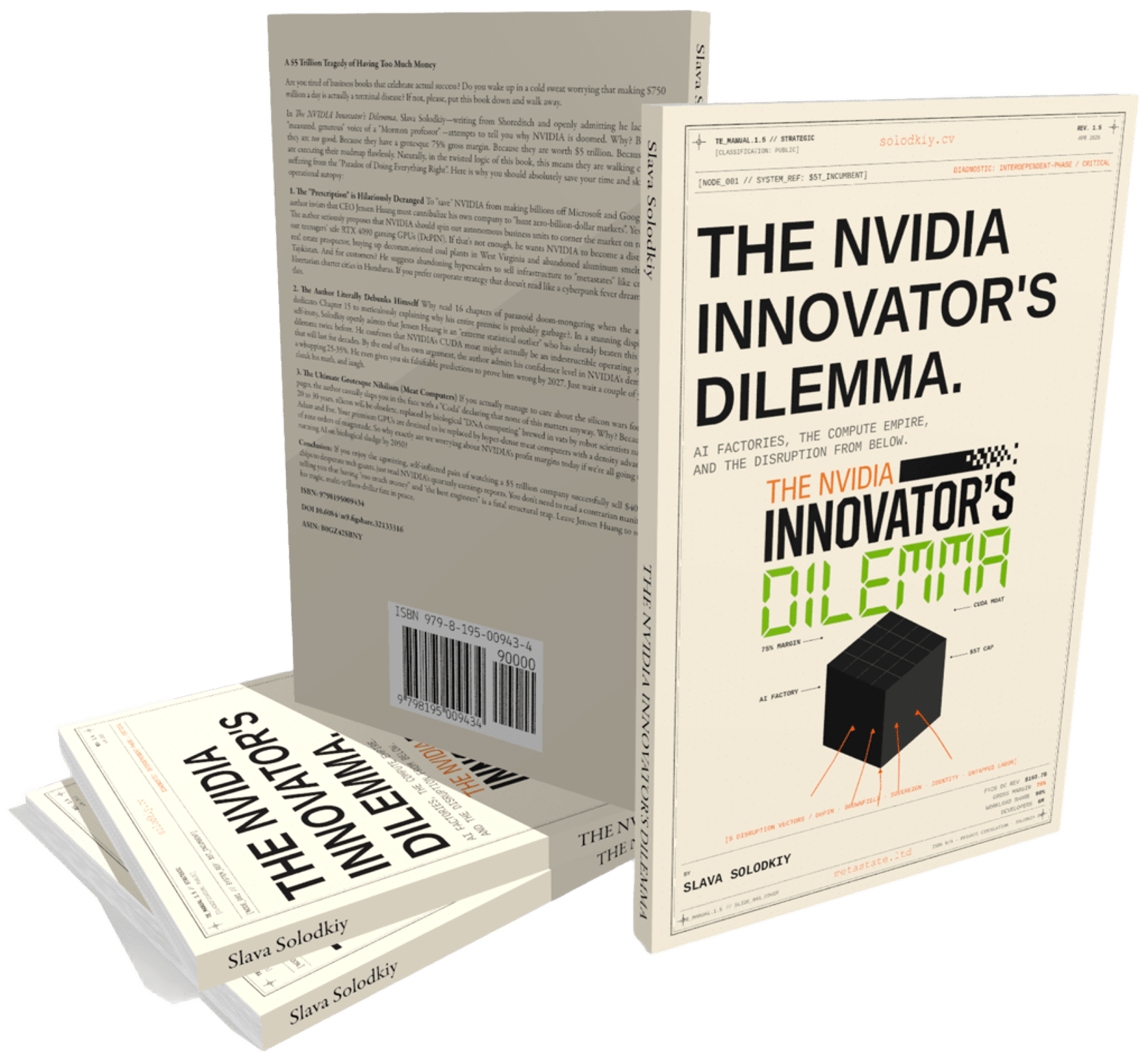
AI FACTORIES, THE COMPUTE EMPIRE, AND THE DISRUPTION FROM BELOW.
NVIDIA is not in trouble despite its excellence. It is in trouble because of it.
Two ways of saying the same thing. Choose your tone. Swipe →
The $5 Trillion Trap.
At a $5 trillion valuation with a 75% gross margin, NVIDIA isn't selling chips — it is levying a relentless tax on the global AI economy. What looks like an impenetrable empire is actually a textbook structural trap.
Three forces are tearing through the foundation: hyperscaler defection to custom ASICs (Google TPU, AWS Trainium, Microsoft Maia, Meta MTIA); the workload shift from premium training to cost-obsessed inference; and the CUDA leak — proprietary lock-in routed around by OpenAI Triton and vLLM.
To survive, Jensen Huang must do the unthinkable: spin out autonomous units, cannibalize his own 75% margins, and risk Wall Street's wrath to capture the invisible markets of tomorrow.
DO NOT READ THIS BOOK.
Are you tired of business books that celebrate actual success? Do you wake up in a cold sweat worrying that making $750 million a day is actually a terminal disease? If not, please put this book down and walk away.
The author seriously proposes that NVIDIA spin out autonomous units to corner the market on renting out teenagers' idle RTX 4090 GPUs (DePIN), buy decommissioned coal plants in West Virginia, and sell infrastructure to crypto-libertarian charter cities in Honduras.
And then a Coda declares that none of this matters, because by 2050 silicon will be replaced by hyper-dense meat computers brewed in vats by robot scientists named Adam and Eve.
Five cracks in the $5T fortress.
None is a single competitor. All are structural responses to the 75% margin.
The Hyperscaler Defection
NVIDIA's 75% gross margin functions as a tax. Google TPU v7, AWS Trainium 3, Microsoft Maia 200, and Meta MTIA represent ~$120B of structural NVIDIA revenue at risk over a five-year roadmap.
Training → Inference Inflection
Two-thirds of AI compute cycles are now inference. NVIDIA's $40,000, 1,000-watt GPUs are wildly over-engineered. Groq, Etched, Cerebras eat the volume layer.
The CUDA Leak
OpenAI Triton, vLLM, MLIR — universal abstraction layers route around the CUDA moat. The DeepSeek moment of April 2026 confirmed: the moat is not breaking, it is being bypassed.
Five new value networks. All ignored by the $5T P&L.
Christensen called them "non-consuming markets." Today they are too small to matter. By 2030 they constitute the next era's infrastructure economy.
DePIN — Airbnb for AI
Aggregated prosumer GPUs (Akash, io.net, Render, Bittensor) at 30–50% of cloud cost. Long tail of compute, structurally protected from NVIDIA pricing power.
Brownfield Energy Arbitrage
Repurposed coal plants, smelters, decommissioned industrial sites. Time-to-power, not FLOPS-per-dollar, is the binding constraint of the late 2020s.
Sovereign AI & Metastates
Nation-states (India, Saudi, UAE, Japan) and the emerging cohort of network states, chartered cities, and special economic zones.
Digital Identity for Agents
Silicon-level attestation and DID/VC infrastructure for the agent economy. By 2030 — Visa for autonomous agents. Today — zero billion dollars.
Untapped Human Capital
Re-entry workers, transitioning veterans, displaced industrial labor, the unhoused, voluntary prison-pilot programs. Christensen's market-creating innovation, applied honestly.
Briefly about the book:
Slide deck, scientific record, podcast walkthrough, video.
The visual blueprint
Fifteen-slide diagnostic deck.
Citable scholarly record
DOI 10.6084/m9.figshare.32133316
Short explainer video
Watch on YouTube.
Podcast walkthrough
Listen on Spotify.
Podcast walkthrough
Listen on Apple Podcasts.
The book, dissected.
Search, filter, and tap to expand. Then test yourself in the quiz.
Decode the dilemma.
One level per crack and pillar. Five questions. Beat them all to unlock the badge.
Paperback and eBook available globally.
Eleven storefronts. Pick your nearest.
Frequently asked.
Is NVIDIA actually doomed?+
The author admits 25–35% confidence in NVIDIA's demise. The book is an 'operational autopsy' of structural risk, not a stock-price prediction.
Why call it a 'dilemma'?+
Because excellent management of the current business is exactly the mechanism of disruption. NVIDIA cannot solve this by being better at what it already does.
Is this an anti-NVIDIA book?+
No. It treats Jensen Huang's track record with respect and explicitly notes he has beaten the dilemma twice before.
What's a 'metastate'?+
An emerging digital-first jurisdiction, network state, or chartered city operating with sovereign authority — Próspera, NEOM, etc.
Where do I start?+
Read the 15-slide SlideShare deck. Then the Q&A here. Then the book.